Saturday, 2 November 2013

West African Music

In my opinion West African music, in contrast to many other forms of world music, is one of the more accessible variants of traditional music in the world in the sense that blues and jazz were both taken from the music of that region.  In short, the music is based heavily on pentatonic improvisation and to the ears of a Western listener it could feel far more familiar and comforting than for example the five or seven tone temperament music from other parts of the world. This is just my thoughts on the music however and may not be relevant to every listener's view on the music. 

(An image showing the general definition of the countries within West Africa)

Firstly, the countries inside west Africa are the following; Senegal, Gambia, Guinea-Bissau, Guinea, Sierra Leone, Liberia, Cote D’Ivoire, Ghana, Togo, Benin, Nigeria, Niger, Burkina Faso and Mali. (i1) The music of the region is branded under several different countries for a number of reasons, their similarity being the most obvious one, but all the countries bar one have previously been under colonial rule and therefore the countries will all share a comparable history of societal and cultural change. 

There seems to be no set written compositional formula for music in West Africa, presumably owing to the die-hard ethos of oral tradition in music. Again it seems almost pointless mentioning that music ties in strongly with dance and dramatics, but performances of any of the three types are more acts of straight expression than performances for amusement in many West African nations. Composition structures are often planned out in the mind and certain musical aspects will be chosen to be part of a composition before it is taught to someone else or performed. So the music remains largely improvisatory but a movement of key or tempo for example will be a determined feature within a piece of music. (3)

A wide number of indigenous instruments are used in the music of this region. One of the most well known of them is the jembe or djembe (the latter being the French spelling used in the French speaking nations of West Africa), a hard wooded goatskin drum which can be played seated or standing.  (5) The instrument produces a mid to high pitched sound which is why it is one of the more distinctive percussive instruments not just in West Africa but across the entire continent. As it comes from the goblet drum family, it shares many similarities with the North African and Arabic doumbek. The djembe however produces a very slightly lower pitched ‘boxier’ sound in comparison.  There are also quite a few stringed instruments put to good use in the music of West Africa, the most recognisable being the electric guitar. The guitar however is played only in one specific way in this style of music, with no chords ever really being played in performances. One characteristic of the electric guitar playing style in West African music is generally major and happy sounding melodies being played on the instrument, usually quite high up the fretboard. The previous sentence however should not be taken as the main characteristic of West African guitar playing, the description is generally correct but could accidentally draw the reader into thinking of Soukous music from further central and south African countries. As blues and jazz both trace back to West Africa, the music from this part of Africa generally sounds almost darker than the hi-life style music of other areas in Africa. 


 (A percussion ensemble featuring at least one djembe)


        (This video gives a rough demonstration of the guitar playing styles in West African music)


Compositions from this form of music will have set aspects that the performer will have to abide by but improvisation is largely encouraged and gives off the impression that a song is more meaningful to the performer if he/her adds their own ideas and abilities to a pre written piece. These improvisations of course depend on a wide array of circumstances and variables (i.e. which instrument is being played, who is playing it, what mood the performer is in, what tempo the song is being performed in, where it is being performed etc). (3)

The West African region has a very dramatic and complex history, particularly from the last two-hundred years or so. Before the mass colonisation of the continent by European nations, the spread of Islam was the major change to West Africa of note. (1) The area was a well known trading centre due to its large natural reserves of luxuries such as gold and ivory, and due to the Americas being at the time still undiscovered, West Africa was perhaps the hallowed ground for potential invaders. And of course before long, Mali (one of the most well known countries in West Africa) was conquered by the Songhai Empire in 1462. (1) As with any invasion, a new ethos of culture is integrated into a country and from that point on any national expression through means of sonic or visual art and literature will be changed in either political stance or through actual changes to the art (musicians using new instruments brought over by new rulers could be one example). The guitar for instance will have originally been inspired by more ancient stringed instruments sourced from across the globe, the electric guitar however is quite an integral part of some West African music and was introduced by the cultural influence of the USA and through attempts of Guinea's government in particular to 'modernise' the culture of the country. (2)
                      
Traditional West African music is currently on a huge rise in terms of influencing musicians from the region and outside of it. Like any other African music, the ‘genre’ has a large following in Belgium and France due to a large number of countries in West Africa having French as their national language and the other two countries for that reason having a number of immigrants from West Africa. Music like Rokia Traore's consists of a sole influence from traditional West African music but features more modern western traits. For an example of the music influencing Western music you need only to look at a few recent hits such as Shakira’s “Waka Waka”, which is admittedly aimed towards a South African vibe but features the distinctive guitar stylings found in music across the entire continent. “Cape Cod Kwassa Kwassa” by Vampire Weekend is another example.
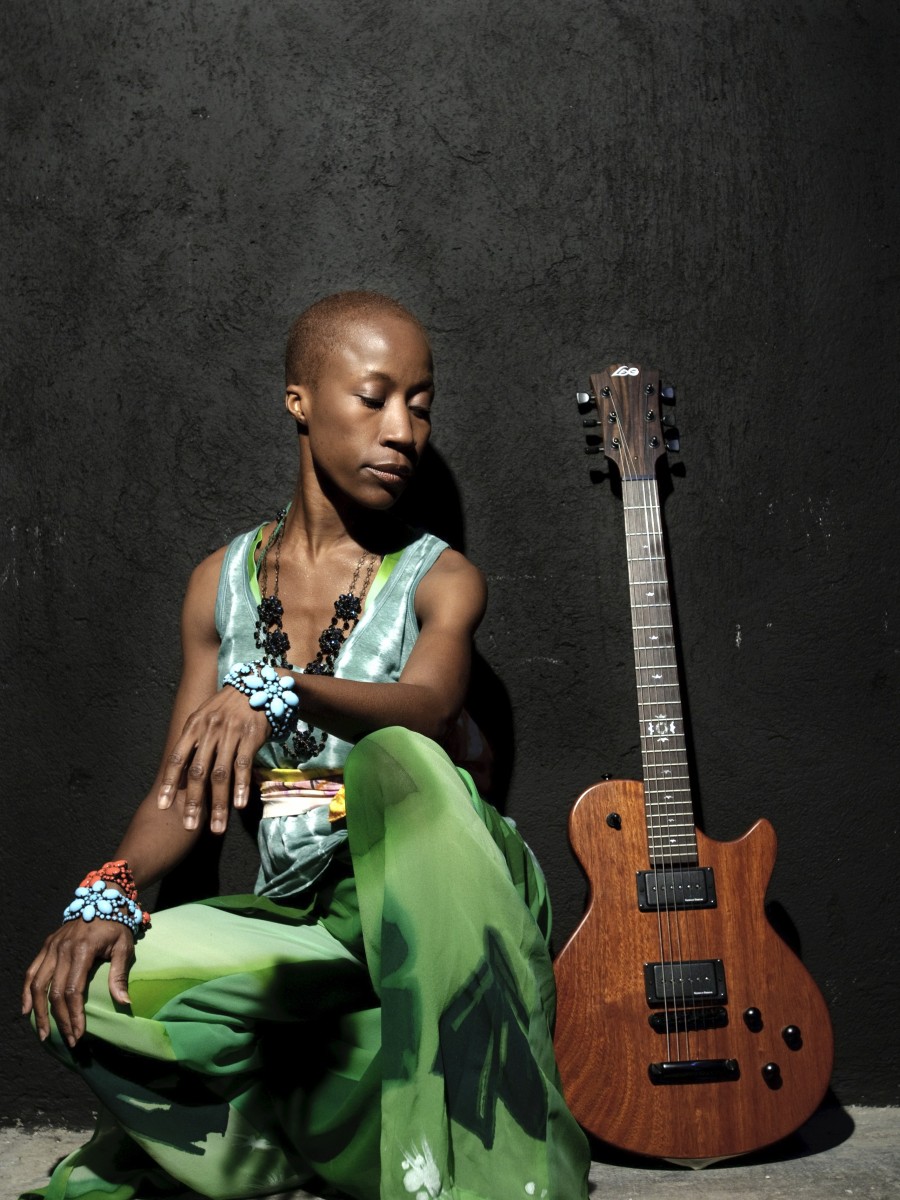
        (pictured: Rokia Traore)


Sources used

(1) Boddy-Evans, A. (?) Trade Across The Sahara. Available at: http://africanhistory.about.com/od/kingdoms/ss/SaharaTradeRoutes.htm (Accessed 23 November 2013)

(2) Charry, E. (?) West African Music. Available at: http://echarry.web.wesleyan.edu/Afmus.html (Accessed 1 November 2013) 

(3) McGraw Hill (?) West African Folk Music. Available at: http://spotlightonmusic.macmillanmh.com/n/teachers/articles/folk-and-traditional-styles/west-african-folk-music (Accessed 1 November 2013)

(4) Exploring Africa (?) Unit three: Studying Africa through the Humanities. Available at: http://exploringafrica.matrix.msu.edu/teachers/curriculum/m13/notes.php (Accessed 2 November 2013)

(5) Mother Rhythm (2013) 10 Facts About the Djembe. Available at: http://motherrhythm.com/articles/10-facts-about-the-djembe/ (Accessed 31 October 2013)


Images and video links

 (i1) Lets Do It World (?) Title unknown. Available at: http://www.letsdoitworld.org/system/files/map_africa_western.gif (Accessed 1 November 2013)

levy Braunstein (2006) Kouyate (Djembe y Dum Dum). Available at: https://www.youtube.com/watch?v=WGOhCh0cWgA (Accessed 30 October 2013)

AcousticGuitarMag (2012) West African Fingerstyle Techniques from Acoustic Guitar. Available at: https://www.youtube.com/watch?v=S7M583vuBag (Accessed 1 November 2013)

Photographer unknown (?) Title unknown. Available at: http://bandonthewall.org/events/3907/ (Accessed 23 November 2013) 

Sunday, 13 October 2013

Indian Traditional Music

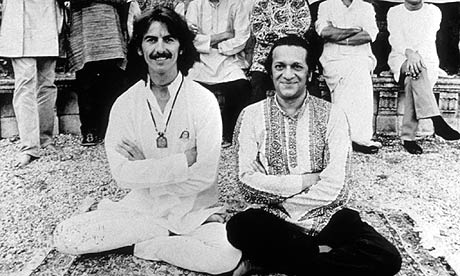
Indian traditional music is one of the most varied and complex types of world music. The music follows well defined theoretical ideas which pre-date any form of western music theory by far. Along with this, music ties in extremely close with religion in India and is seen in a number of important ways such as a channel for spirituality or well being.  As a ‘world music’, India specifically gained a heavy amount of interest from the western world during the mid to late sixties through George Harrison’s sudden  obsession with the country’s advanced perceptions and approaches to music.(6) There are a number of different stories as to what led to his fondness of the music of India but what remains undeniable is that both he and Shankar became a key connection between the music of India and the west. (6) (10) 

(pictured: George Harrison and Ravi Shankar)


At the earliest, a piece of scholarly work called ‘Natyashastra’ was written in the second century BC. Although the work covers all types of performing arts it contains many ideals on music which has been generally abided by in India since it’s time of writing, giving us the idea that the Indian music we recognise today was formed around that time. (8) There is a noticeable divide in the characteristics of music from the north of india and that of the south. A general opinion is that the music from the north is open to more influence from the countries surrounding it whereas the southern music remains more ‘conforming’ to Indian traditions.(14) This opinion however has to be taken in hand with the fact that the north of India fell under Muslim rule for quite an extensive period. Music from the north of India is called Hindustani music and music from the south is called Carnatic. (6)


Indian music in terms of structure is based around two relatively simple concepts, rag and tal. Rag is the term used to describe the melody of a composition and tal is the rhythmic section. Rag is similar to what we in the west would know as a scale but with a few differences.  Rags are counted as Sa, Re, Ga, Ma, Pa, Dha, Ni, Sa (rather alike the do re mi scale counting system). Regarding structure, ragas are generally of an ‘AB’ structure with the first section of the raga called ‘alap’ and the second called ‘gat’. The alap stereotypically defines the feeling or ethos of the song and will more frequently than not stick to a single droned note, or key.  Alap also lacks much of a rhythmic intensity. The gat section of a raga is where the rhythmic elements of a piece become more noticeable and everything contributing melody builds together often to a frenzied climatic ending with displays of extreme virtuosity a common sight. (3)


     (A video briefly explaining the basics of Indian music)


As a form of world music, Indian traditional music has arguably gained far more attention and appreciation in the West than any other countries’.  Whilst George Harrison and other 60’s musicians associated with psychedelia are the main credit to popularising the music towards western listeners, a number of significant musicians had adapted traits of Indian music into their own in some minor detail.  Gustav Holst composed ‘Savitri’ in 1908, a piece which is based on Hindu literature more than music admittedly, but it was still one of the first representations of Indian culture influencing the western world.(2) Immigration also played an extremely important role, with Indian citizens being allowed to move and settle in the UK due to a 1948 commonwealth act (which also helped other forms of world music shape the music of Britain).(1) After the initial trouble Indians had been confronted by with the British public, people began to realise the cultural diversity these new citizens held and before long people were deeply immersing themselves in Indian culture.  George Harrison was one of those people, and due to his already huge celebrity status, the public also embraced a huge turn-around in their attitude towards Indian immigrants. (11)

The sitar, a traditional Indian instrument, is one of the most recognisable non-western instruments worldwide. The instrument again gained attention in the sixties and was used in a number of western rock albums. The sitar however does not always form the base drone in Indian compositions. In fact, they are very rarely used as the principal droning instrument as a similar instrument called a tanpura or tambura is used for this purpose.(9) (14) The tanpura is a smaller looking sister instrument to the sitar but contains a large number of differences,  a tanpura has no frets and only four strings as opposed to the sitar’s 19 frets and 18 strings (both of these numbers vary). It is tuned to the tonic and is only ever droned in performances. Whilst it may look a bright side smaller than a sitar the pitch and dynamic presence of the drone largely remains just as low and powerful when played on a tanpura. Of course it would be ignorant of me to not mention a few other stringed instruments used in Indian traditional music, I will however only mention a few as there is quite a large number of the instruments and even more variants of each instrument. The third most popular stringed instrument is the veena which exists in both fretted and an unfretted form and is coined as either a rudra veena or a saraswati veena dependant on whether it is being used in Hindustani or karnatic music. Another instrument is the surbahar which is more similar to the sitar than anything but differs in that it has fixed frets and a wider and longer neck, giving it an extremely deep bass tone. A sarangi is a completely fretless stringed instrument which is bowed. It has an extremely large amount of strings, most of which are sympathetic, as only three thick strings are bowed whilst another thirty-five are left to resonate the sound of the instrument. The final stringed instrument I will briefly mention is the surmandal, a zither like instrument often used to accompany female vocalists in Indian music. (12) (13) (14)


 (A stereotypical tanpura)


Sources used

(1) British Library (?) Immigration from India. Available at: http://www.bl.uk/learning/timeline/item107671.html (Accessed at: 8 October 2013)

(2) Taylor, K. (2007) Compositions The Music Of Gustav Holst. Available at: http://www.gustavholst.info/compositions/listing.php?work=49 (Accessed at: 11 October 2013)

(3) Tóth, S. (?) The raga's structure. Available at: http://india.tilos.hu/english_ragarend.html (Accessed at: 8 October 2013)

(4) Scaruffi, P. (2002) A brief summary of Indian music. Available at: http://www.scaruffi.com/history/indian.html (Accessed at: 7 October 2013)

(5) Courtney, D. (2012) Overview Of Indian Classical Music. Available at: http://chandrakantha.com/articles/indian_music/ (Accessed at: 7 October 2013)

(6) Manas. (?) Indian Music. Available at: http://www.sscnet.ucla.edu/southasia/Culture/Music/Music.html (Accessed 12 October 2013)

(7) Shahani, U. (?) Introduction to Indian Classical Music. Available at: (http://www.likhati.com/introduction-to-indian-classical-music/ (Accessed at 11 October 2013)

(8) Balu, Y. (2010) Natya Sastra. Available at: http://natyasastraced.blogspot.co.uk/ (Accessed 9 October 2013)

(9)  Shahani, U. (2009) T is for Tanpura not Sitar; it's good to know the difference. Available at: http://www.likhati.com/2009/01/19/t-is-for-tanpura-not-sitar-its-good-to-know-the-difference/ (Accessed at 11 October 2013)

(10) Ghosh, P. (2011) George Harrison and India: The Real 'Magical Mystery Tour'. Available at: http://www.ibtimes.com/george-harrison-india-real-magical-mystery-tour-212539 (Accessed 11 October 2013)

(11) National Archives (?) Postwar immigration. Available at: http://www.nationalarchives.gov.uk/pathways/citizenship/brave_new_world/immigration.htm (Accessed 7 October 2013) 

(12) Courtney, D. (2012) Tanpura or Tambura. Available at: http://chandrakantha.com/articles/indian_music/tanpura.html (Accessed 7 October 2013)

(13) Courtney, D. (2012) The Sitar: An Overview. Available at: http://chandrakantha.com/articles/indian_music/sitar.html (Accessed 7 October 2013)

(14) World Music: The Rough Guide, Latin and North America, Caribbean, India, Asia and Pacific (2000) London: Rough Guides, New Edition (Pages 72 & 73 regarding instrument descriptions) (Page 71 regarding the 'purity' of karnatic music and it's closer ties with hinduism)

Images and video links,

Features, R. (?) Sitar Stars. Available at: http://static.guim.co.uk/sys-images/Music/Pix/pictures/2010/8/18/1282127147656/George-Harrison-and-Ravi--006.jpg (Accessed 11 October 2013) 

EmoryUniversity (2010) Understanding the Basics of Indian Raga Music. Available at: http://www.youtube.com/watch?v=nom-_EYjIrg (Accessed 23 November 2013) 


Photographer unknown (?) banjira 38" Flat Back Inlay Indian Tanpura + Hard Case. Available at: http://www.ethnicmusicalinstruments.com/banjira-38-Inch-Flat-Back-Inlay-Indian-Tanpura-Hard-Case.html (Accessed 8 October 2013)


Saturday, 28 September 2013

Norwegian Traditional Music

As a guess, the traditional music of Norway would share many extreme similarities with that of the rest of Scandinavia. Owing to the region's geographical location the area presumably draws and delivers influence from Germanic, Arctic and possibly even Celtic cultures. Norwegian music varies hugely according to different regions and dialects within different parts of the country (apparently more drastically than that of other European cultures).


Song structures

Instrumental music is called either "Slattemusikk" or "Bygdedans" and unsurprisingly both have strong ties with traditional dance also. Music in this style is typically measured whether it is in 2/4, 3/4 or 6/8 timing, after which it is entitled under a certain name (either a dance style or a music style). (1/3)

3/4 time:
Bygdedans in this timing is called either springar, pols, springleik, rundom or springdans but again there are far more names due to the regional differences. (3)

2/4 & 6/8 time:
Bygdedans following these two timings are often danced with couples in which case they are called; gangar, rull or bonde. They can also be danced solo where they would be entitled halling or laus. (3)


Instruments


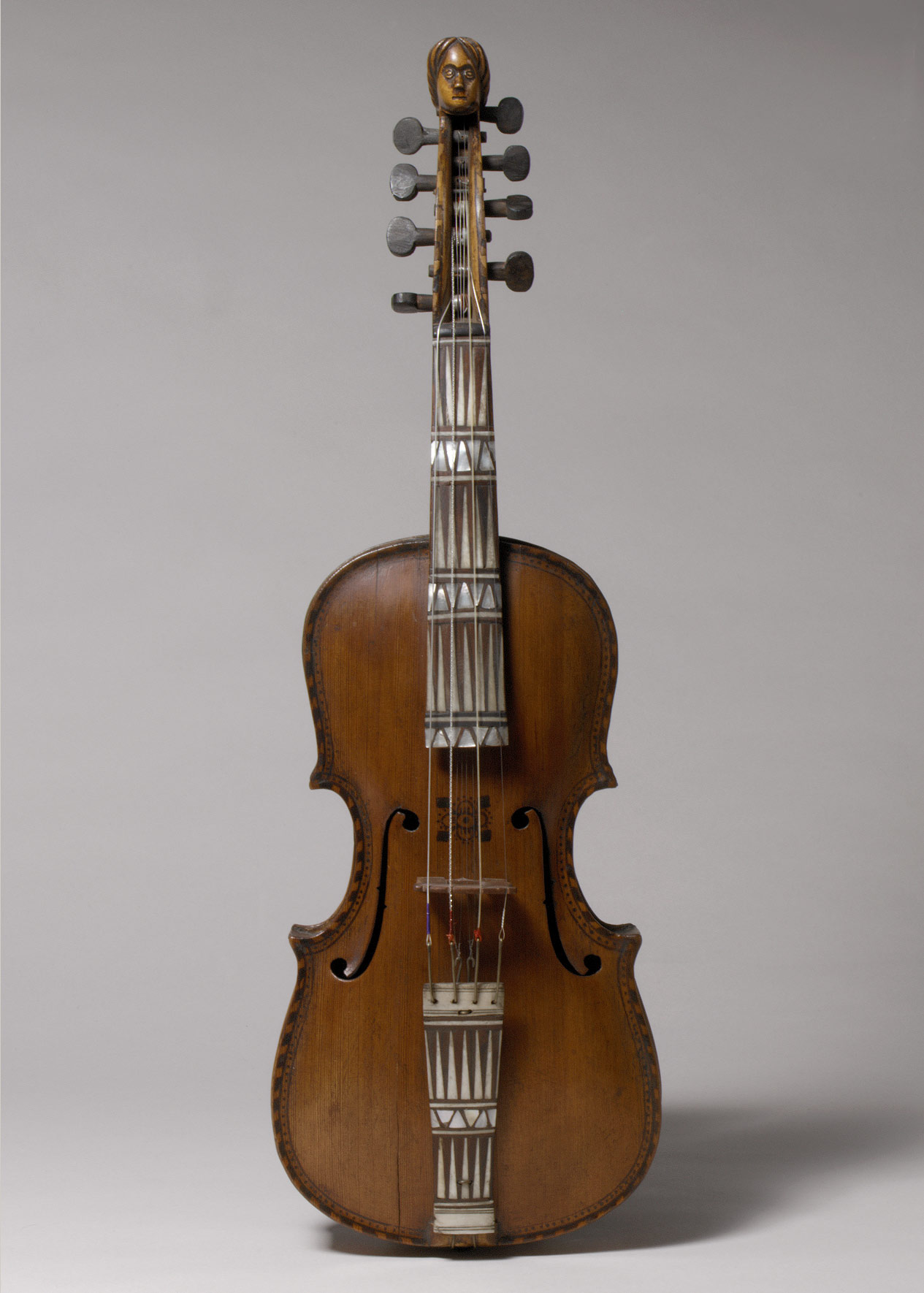
The most common instrument used in Norwegian music is the Hardanger fiddle which is apparently seen as the national instrument of Norway. The 'hardingfele' is a transposing instrument and is usually tuned A,D,A,E, the instrument has eight strings where pairs of strings are tuned to compliment eachother (known as sympathetic strings). These sympathetic strings are typically tuned D,E,F#,A and some variants also have a low B preceeding the other four sympathetic strings. The other main difference between the Hardanger fiddle and a traditional is it's slight constructional differences and is heavily ornamented. The ornamentation contains mainly 'rosing', which is inked patterns and decorations. Along with this they usually have a carved headstock usually based on a maiden or a powerful animal. The instrument is thought to have originated from a region around the Hardanger fjord (which is where the English name is drawn from). It had become the dominant instrument in Norwegian music by the 1700's but scholars believe the instrument could have been first created around half a century earlier. The sound of the instrument can be easily distinguished and was famously used in a number of compositions for the Lord Of The Rings film and game series (the themes within Rohan particularly). (2/4/5)


There are a number of different wind instruments used in slatte music. Willow flutes, ram's horns and neverlurs were used less frequently due to their original functions for work. Even older wind instruments were mainly used by shepherds and sometimes used in the traditional music of Norway. Some of these instruments include; boneflute, neverlapp, tungehorn and very basic home constructed instruments similar to clarinets. (1)

The northern parts of Norway boast cultural influence from the Sami people (the indigenous peoples of Lapland) who use a powerful chanting technique called joik. (2)

Modern following and variants

As with many styles of world music, this gained a resurgence of interest and popularity in the 20th century which is still ongoing. As far as variations and adaptions into new music has stretched, there is a small interest from the infamous Norwegian black metal scene. Whilst the two styles share nothing with each other and to date I cannot think of any direct musical combination, numerous black metal bands have side projects devoted to performing traditional Norwegian music (the more intimidating and bleaker styles anyway).


The traditional music of Norway has been aurally transmitted through the years and is still taught in the same method today. (3)


Sources used

(1) Norwegian Folk Music (1997) Norwegian Folk Music. Available at: http://home.online.no/~kgjetmun/ (Accessed: 27 September 2013)

(2) Music From Norway (?) Traditional Music. Available at: http://www.musicfromnorway.com/default.aspx?norwegian=album&music=-104 (Accessed 27 September 2013)

(3) Folkemusikk.no (?) Norwegian Traditional Music. Available at: http://www.folkemusikk.no/norwegian-traditional-music.137786.no.html (Accessed 27 September 2013)

(4) Hardanger Fiddle Association of America (?) What is a Hardanger fiddle?. Available at: http://www.hfaa.org/Home/about-the-hardanger-fiddle (Accessed 27 September 2013)

(5) Code, K.L (?) A Guide to Tunings on the Hardingfele.  Available at: http://www.hfaa.org/Home/articles-on-the-hardanger-fiddle/a-guide-to-tunings-on-the-hardingfele (Accessed 28 September 2013)

Images and video links

The Metropolitan Museum of Art (2013) Hardanger Fiddle. Available at: http://www.metmuseum.org/collections/search-the-collections/503795 (Accessed 28 September 2013)

pcgamer (2012) Behind the music of LotRO's Riders of Rohan expansion. Available at: https://www.youtube.com/watch?feature=player_embedded&v=0OPsmQRmmK8 (Accessed 27 September 2013)

wardruna (2009) Hagal (Live at Incubate 2009). Available at: https://www.youtube.com/watch?feature=player_embedded&v=CoaGMb8p_PY (Accessed 28 September 2013)