Indian
traditional music is one of the most varied and complex types of world music.
The music follows well defined theoretical ideas which pre-date any form of
western music theory by far. Along with this, music ties in extremely close
with religion in India and is seen in a number of important ways such as a
channel for spirituality or well being.
As a ‘world music’, India specifically gained a heavy amount of interest
from the western world during the mid to late sixties through George Harrison’s
sudden obsession with the country’s
advanced perceptions and approaches to music.(6) There are a number of different stories as to
what led to his fondness of the music of India but what remains undeniable is
that both he and Shankar became a key connection between the music of India and the west. (6) (10)
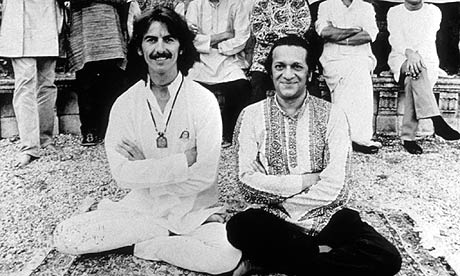
(pictured: George Harrison and Ravi Shankar)
At the
earliest, a piece of scholarly work called ‘Natyashastra’ was written in the second century BC. Although the
work covers all types of performing arts it contains many ideals on music which
has been generally abided by in India since it’s time of writing, giving us the
idea that the Indian music we recognise today was formed around that time.
(8) There is a noticeable divide in the characteristics of music from the north of
india and that of the south. A general opinion is that the music from the north
is open to more influence from the countries surrounding it whereas the
southern music remains more ‘conforming’ to Indian traditions.(14) This opinion however has to be taken in hand with the fact that the north of India fell under Muslim rule for quite an extensive period. Music from the
north of India is called Hindustani music and music from the south is called
Carnatic. (6)
Indian music in terms of structure is based around two relatively
simple concepts, rag and tal. Rag is the term used to describe the melody of a
composition and tal is the rhythmic section. Rag is similar to what we in the
west would know as a scale but with a few differences. Rags are counted as Sa, Re, Ga, Ma, Pa, Dha,
Ni, Sa (rather alike the do re mi scale counting system). Regarding structure,
ragas are generally of an ‘AB’ structure with the first section of the raga
called ‘alap’ and the second called ‘gat’. The alap stereotypically defines the
feeling or ethos of the song and will more frequently than not stick to a
single droned note, or key. Alap also
lacks much of a rhythmic intensity. The gat section of a raga is where the
rhythmic elements of a piece become more noticeable and everything contributing
melody builds together often to a frenzied climatic ending with displays of extreme
virtuosity a common sight. (3)
(A video briefly explaining the basics of Indian music)
The sitar, a traditional Indian instrument, is one of the most
recognisable non-western instruments worldwide. The instrument again gained
attention in the sixties and was used in a number of western rock albums. The
sitar however does not always form the base drone in Indian compositions. In
fact, they are very rarely used as the principal droning instrument as a
similar instrument called a tanpura or tambura is used for this purpose.(9) (14) The
tanpura is a smaller looking sister instrument to the sitar but contains a
large number of differences, a tanpura
has no frets and only four strings as opposed to the sitar’s 19 frets and 18
strings (both of these numbers vary). It is tuned to the tonic and is only ever
droned in performances. Whilst it may look a bright side smaller than a sitar
the pitch and dynamic presence of the drone largely remains just as low and
powerful when played on a tanpura. Of course it would be ignorant of me to not
mention a few other stringed instruments used in Indian traditional music, I
will however only mention a few as there is quite a large number of the
instruments and even more variants of each instrument. The third most popular
stringed instrument is the veena which exists in both fretted and an unfretted
form and is coined as either a rudra veena or a saraswati veena dependant on
whether it is being used in Hindustani or karnatic music. Another instrument is
the surbahar which is more similar to the sitar than anything but differs in
that it has fixed frets and a wider and longer neck, giving it an extremely
deep bass tone. A sarangi is a completely fretless stringed instrument which is
bowed. It has an extremely large amount of strings, most of which are
sympathetic, as only three thick strings are bowed whilst another thirty-five are
left to resonate the sound of the instrument. The final stringed instrument I
will briefly mention is the surmandal, a zither like instrument often used to
accompany female vocalists in Indian music. (12) (13) (14)

(A stereotypical tanpura)
Sources used
(1) British Library (?) Immigration from India. Available at: http://www.bl.uk/learning/timeline/item107671.html (Accessed at: 8 October 2013)
(2) Taylor, K. (2007) Compositions The Music Of Gustav Holst. Available at: http://www.gustavholst.info/compositions/listing.php?work=49 (Accessed at: 11 October 2013)
(3) Tóth, S. (?) The raga's structure. Available at: http://india.tilos.hu/english_ragarend.html (Accessed at: 8 October 2013)
(4) Scaruffi, P. (2002) A brief summary of Indian music. Available at: http://www.scaruffi.com/history/indian.html (Accessed at: 7 October 2013)
(5) Courtney, D. (2012) Overview Of Indian Classical Music. Available at: http://chandrakantha.com/articles/indian_music/ (Accessed at: 7 October 2013)
(6) Manas. (?) Indian Music. Available at: http://www.sscnet.ucla.edu/southasia/Culture/Music/Music.html (Accessed 12 October 2013)
(7) Shahani, U. (?) Introduction to Indian Classical Music. Available at: (http://www.likhati.com/introduction-to-indian-classical-music/ (Accessed at 11 October 2013)
(8) Balu, Y. (2010) Natya Sastra. Available at: http://natyasastraced.blogspot.co.uk/ (Accessed 9 October 2013)
(9) Shahani, U. (2009) T is for Tanpura not Sitar; it's good to know the difference. Available at: http://www.likhati.com/2009/01/19/t-is-for-tanpura-not-sitar-its-good-to-know-the-difference/ (Accessed at 11 October 2013)
(10) Ghosh, P. (2011) George Harrison and India: The Real 'Magical Mystery Tour'. Available at: http://www.ibtimes.com/george-harrison-india-real-magical-mystery-tour-212539 (Accessed 11 October 2013)
(11) National Archives (?) Postwar immigration. Available at: http://www.nationalarchives.gov.uk/pathways/citizenship/brave_new_world/immigration.htm (Accessed 7 October 2013)
(12) Courtney, D. (2012) Tanpura or Tambura. Available at: http://chandrakantha.com/articles/indian_music/tanpura.html (Accessed 7 October 2013)
(13) Courtney, D. (2012) The Sitar: An Overview. Available at: http://chandrakantha.com/articles/indian_music/sitar.html (Accessed 7 October 2013)
(14) World Music: The Rough Guide, Latin and North America, Caribbean, India, Asia and Pacific (2000) London: Rough Guides, New Edition (Pages 72 & 73 regarding instrument descriptions) (Page 71 regarding the 'purity' of karnatic music and it's closer ties with hinduism)
Images and video links,
Features, R. (?) Sitar Stars. Available at: http://static.guim.co.uk/sys-images/Music/Pix/pictures/2010/8/18/1282127147656/George-Harrison-and-Ravi--006.jpg (Accessed 11 October 2013)
EmoryUniversity (2010) Understanding the Basics of Indian Raga Music. Available at: http://www.youtube.com/watch?v=nom-_EYjIrg (Accessed 23 November 2013)
Photographer unknown (?) banjira 38" Flat Back Inlay Indian Tanpura + Hard Case. Available at: http://www.ethnicmusicalinstruments.com/banjira-38-Inch-Flat-Back-Inlay-Indian-Tanpura-Hard-Case.html (Accessed 8 October 2013)
Images and video links,
Features, R. (?) Sitar Stars. Available at: http://static.guim.co.uk/sys-images/Music/Pix/pictures/2010/8/18/1282127147656/George-Harrison-and-Ravi--006.jpg (Accessed 11 October 2013)
EmoryUniversity (2010) Understanding the Basics of Indian Raga Music. Available at: http://www.youtube.com/watch?v=nom-_EYjIrg (Accessed 23 November 2013)
Photographer unknown (?) banjira 38" Flat Back Inlay Indian Tanpura + Hard Case. Available at: http://www.ethnicmusicalinstruments.com/banjira-38-Inch-Flat-Back-Inlay-Indian-Tanpura-Hard-Case.html (Accessed 8 October 2013)

No comments:
Post a Comment